
Hong Kong – AI in the Corridors of Power: Can Large Language Models Reshape Policy and Diplomacy?
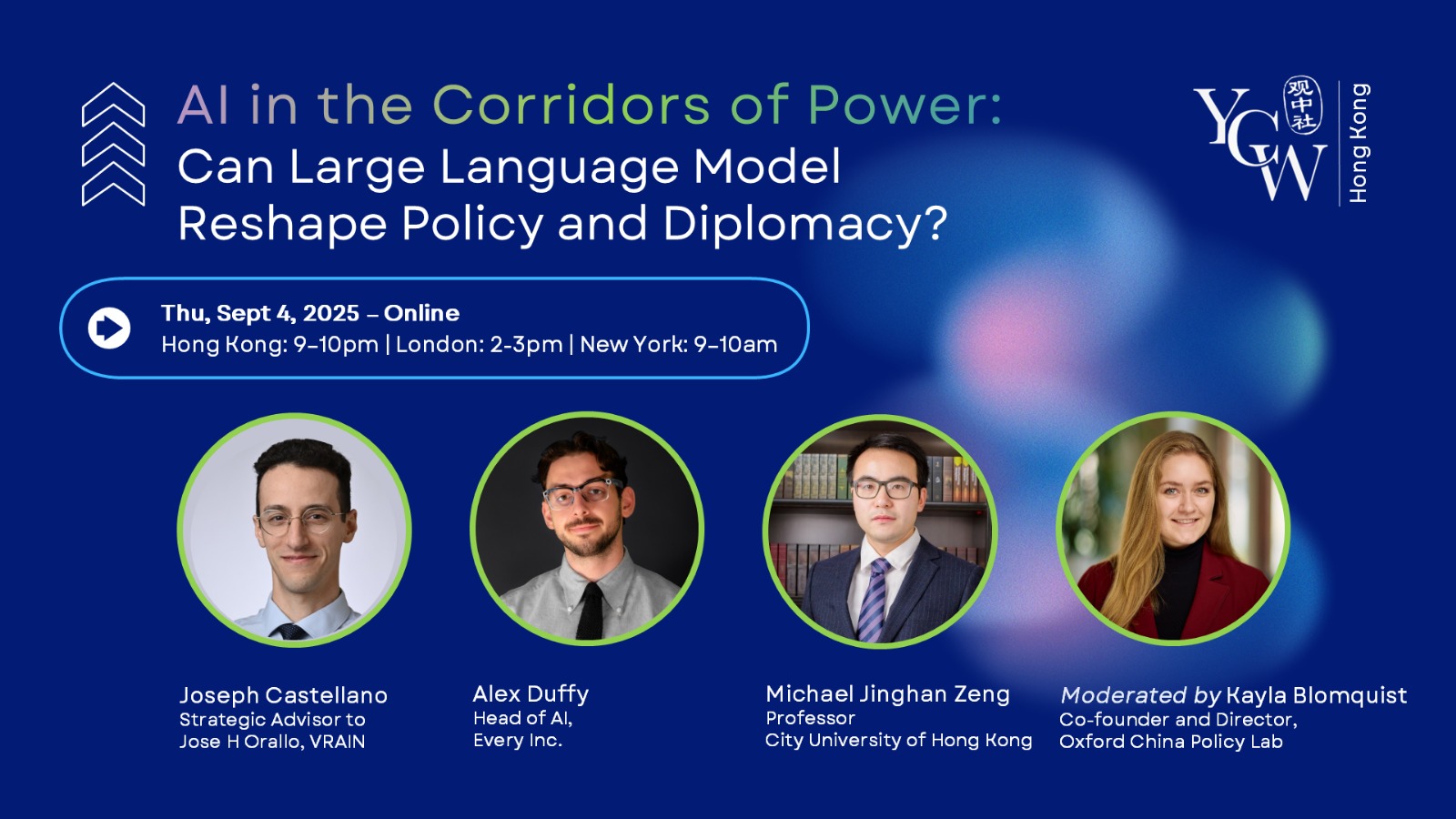
On September 4, Young China Watchers’ Hong Kong chapter hosted a virtual panel examining how Artificial Intelligence (AI) is beginning to transform diplomacy and policymaking. The discussion weighed the opportunities and risks of using AI. While AI can improve translation, scenario planning, and information gathering, it also raises profound risks ranging from echo chambers and manipulation of public opinion to the erosion of human trust and judgment.
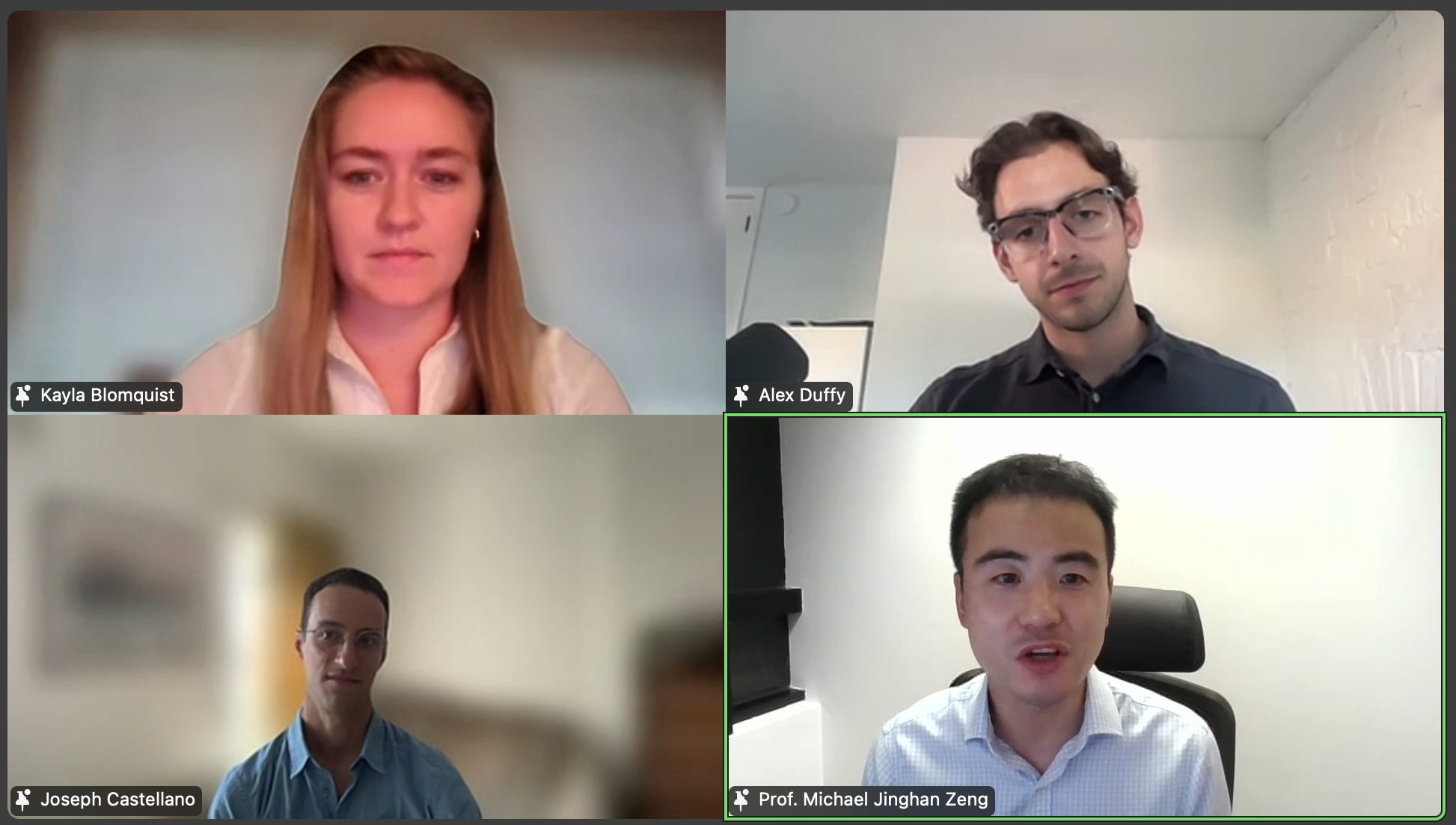
The event featured Joseph Castellano (Strategic Advisor to Jose H Orallo, VRAIN), Alex Duffy (Head of AI, Every Inc.), and Professor Michael Jinghan Zeng, PhD FHEA (Professor, Department of Public and International Affairs, City University of Hong Kong), who also explored China’s AI strategy, the implications of linguistic and cultural divides in AI development, and the importance of preserving human agency in the age of AI. The conversation was moderated by Kayla Blomquist, Co-founder and Director of the Oxford China Policy Lab & Researcher at the Oxford Internet Institute. All speakers shared their views in a personal capacity.
AI as a Double-Edged Sword
The panel opened with reflections on the promise and pitfalls of integrating AI into diplomacy and policymaking. Castellano noted that LLMs can help officials “think better” by organizing complex information, but warned against heavy reliance on systems that may present inaccurate or biased outputs. Duffy concurred and described AI as a “double-edged sword,” useful for generating perspectives and simulating scenarios but also prone to reinforcing echo chambers if left unchecked.
Blomquist highlighted potential applications such as predicting how world leaders might react to policy proposals or drafting travel advisories, but stressed the need for skilled human oversight. Zeng pointed to China’s increasing integration of AI into government functions, from the Ministry of Foreign Affairs to local governance, describing how Chinese-developed models such as DeepSeek are tailored to the country’s linguistic and cultural context. While current uses remain basic, such as translation or polishing arguments, Zeng cautioned that long-term dependence on AI in diplomacy risks losing the human touch— body language, the words said and unsaid, relationship-building—and ultimately, trust, which remains central to international negotiations.
Defining Safety and Preserving Human Agency
A recurring theme was the question of AI “safety” in a geopolitical context. Castellano argued that AI must “augment human judgment, not replace it,” preserving cultural intuitions while making clear what systems cannot know. Duffy encouraged diplomats to engage AI in a way that is exploratory rather than prescriptive, using it to challenge their own thinking rather than accept its outputs uncritically.
All speakers agreed that maintaining human agency is critical. Castellano stressed that diplomacy is inherently human, involving nuance and empathy that AI cannot replicate. At best, LLMs can prepare officials for negotiations by processing vast datasets or simulating scenarios, but the actual engagement must remain person-to-person.
China’s AI Strategy and Global Competition
On U.S.-China competition, Zeng described China’s mixed reactions to the development of ChatGPT in the United States: admiration for its groundbreaking innovation, coupled with anxiety about falling behind in a domain with clear geopolitical stakes. Beijing views U.S. advances in AI through a security lens, concerned about potential manipulation of public opinion and foreign interference in Chinese politics. He observed that Chinese AI strategy often responds to U.S. development, while also being shaped by China’s socio-economic environment and its ambition to become an AI superpower by 2030. At the same time, China has also positioned itself as a proponent of multilateral AI governance, particularly with countries in the Global South and through UN platforms.
Language, Inequality, and Global Order
A major concern raised by panelists was digital inequality in language representation. Because LLMs are overwhelmingly trained on English, and to a lesser extent Chinese, countries with less widely used languages risk marginalization in the AI age. Castellano pointed out that “low-resource languages,” especially those not well represented online, are poorly served by current models, creating risks for communities whose perspectives may be excluded. Duffy cited the predominance of English even at international conferences, while Zeng warned that digital inequality could exacerbate broader geopolitical divides, leaving countries without advanced AI capabilities more dependent on foreign systems.
Governance, Transparency, and the Future of Diplomacy
The conversation turned to the governance of AI in global affairs. Panelists agreed that while AI could enhance information gathering, translation, and cultural contextualization, its role in actual decision-making should be limited. Over-reliance on AI in areas such as military planning or intelligence could have disastrous consequences if human oversight is sidelined.
Both Duffy and Castellano emphasized the importance of transparency: diplomats must be aware of the data an AI system is trained on, the confidence levels of its outputs, and its potential biases. Used responsibly, AI could help officials generate multiple perspectives on a problem and think more creatively. But if deployed without safeguards, it risks amplifying disinformation, accelerating public opinion manipulation, and undermining international trust.
Conclusion
The speakers concluded on a note of cautious optimism. While AI will not replace the human elements of diplomacy, it has the potential to augment policymaking and enhance cross-cultural understanding if used wisely. The challenge ahead lies in establishing international safeguards, ensuring linguistic and cultural inclusivity, and balancing innovation with responsibility.
The real question is not whether AI can be used in diplomacy, but to what extent we should allow it into decision-making. The human dimension—empathy, trust, and judgment—remains indispensable in the corridors of power.
Author: Emily Brignand. Emily is an Editorial Director at Young China Watchers and currently serves as a Fulbright English Teaching Assistant in Mongolia. She earned her Bachelor of Arts in International Studies from American University, with a focus on China and East Asia.