Voices on China – Rosie Levine on What It Means to Understand China Today
Rosie Levine is the Executive Director of the US-China Education Trust (USCET), a nonprofit based in Washington, DC and housed at the George Washington University Elliott School of International Affairs. USCET focuses on the role of higher education in the U.S.-China relationship, aiming to build a pipeline of Americans with deep expertise on China and Chinese with deep expertise on the United States to help prevent misunderstandings that could lead to conflict. The organization views education, culture, and people-to-people exchange as a stabilizing force in bilateral relations.
Rosie has spent the past decade in the China field, beginning with early on-the-ground experience in Beijing and later holding leadership roles at institutions like the National Committee on U.S.-China Relations and the U.S. Institute of Peace. Her work has consistently centered on strengthening mutual understanding between the two countries.
Today, as many China-related organizations navigate a more constrained and complex environment for exchange, Rosie has also been closely involved in shaping conversations about the future of the field, including through USCET’s recent working group report on America’s China talent challenge. At the same time, she recently stepped down as a DC Chapter Head of Young China Watchers (YCW), marking a transition point in her own leadership journey within the next-generation China community.
In this conversation, we reflect on her path into the field, the evolution of USCET and YCW, and how recent shifts—from declining study abroad opportunities to rising geopolitical tensions—are reshaping what it means to build U.S.-China understanding today.

Rosie Levine is the Executive Director of US-China Education Trust. Image provided by Rosie Levine.
YCW: You’ve been in the China field for over a decade, with both on-the-ground experience in China and policy-facing roles in the U.S. How has the field changed over that time?
RL: The field has absolutely transformed. I arrived in Beijing in 2014, after growing up there and studying Mandarin, at a time when there was a large cohort of Americans eager to engage with China. There were over 15,000 Americans studying in China, and a strong sense of curiosity on both sides. That was really the peak of people-to-people exchange.
Fast forward to today, and that number has dropped to around 2,000. Beyond the numbers, there’s been a deeper shift: access has become more limited, and attitudes on both sides have changed. There’s less interest in supporting exchange, and even the value of mutual understanding is sometimes questioned. It really feels like a door has closed behind my generation, and that will have long-term implications for how the U.S. understands China moving forward.
YCW: Was there a particular moment that shifted how you saw U.S.-China relations?
RL: One moment that stands out was the beginning of the trade war. I was studying at the Yenching Academy at Peking University at the time, as part of a very international cohort. We were all trying to understand China’s role in the world, and suddenly the framing of U.S.-China relations shifted from largely positive, with some disagreements, to something much more adversarial.
What struck me was the confusion among my international peers and on the Chinese side. People were asking, “Why is this happening?” That moment marked a turning point in how the relationship has been understood ever since, and many of those questions remain unresolved today.
YCW: You recently stepped down as DC Chapter Head of YCW. What has that community meant to you?
RL: Young China Watchers is an incredibly special community. I’ve been involved in Beijing, New York, and DC, and in every city I’ve been struck by the depth and diversity of China expertise. What makes YCW unique is that it brings together people who might not otherwise meet—those who studied in China, worked there, or simply have a strong interest.
It’s also a space where people can stay engaged with China even if their careers take them in different directions. That’s really important, because it’s not always easy to translate China experience into a job. YCW helps keep that interest alive through events, discussions, and connections.
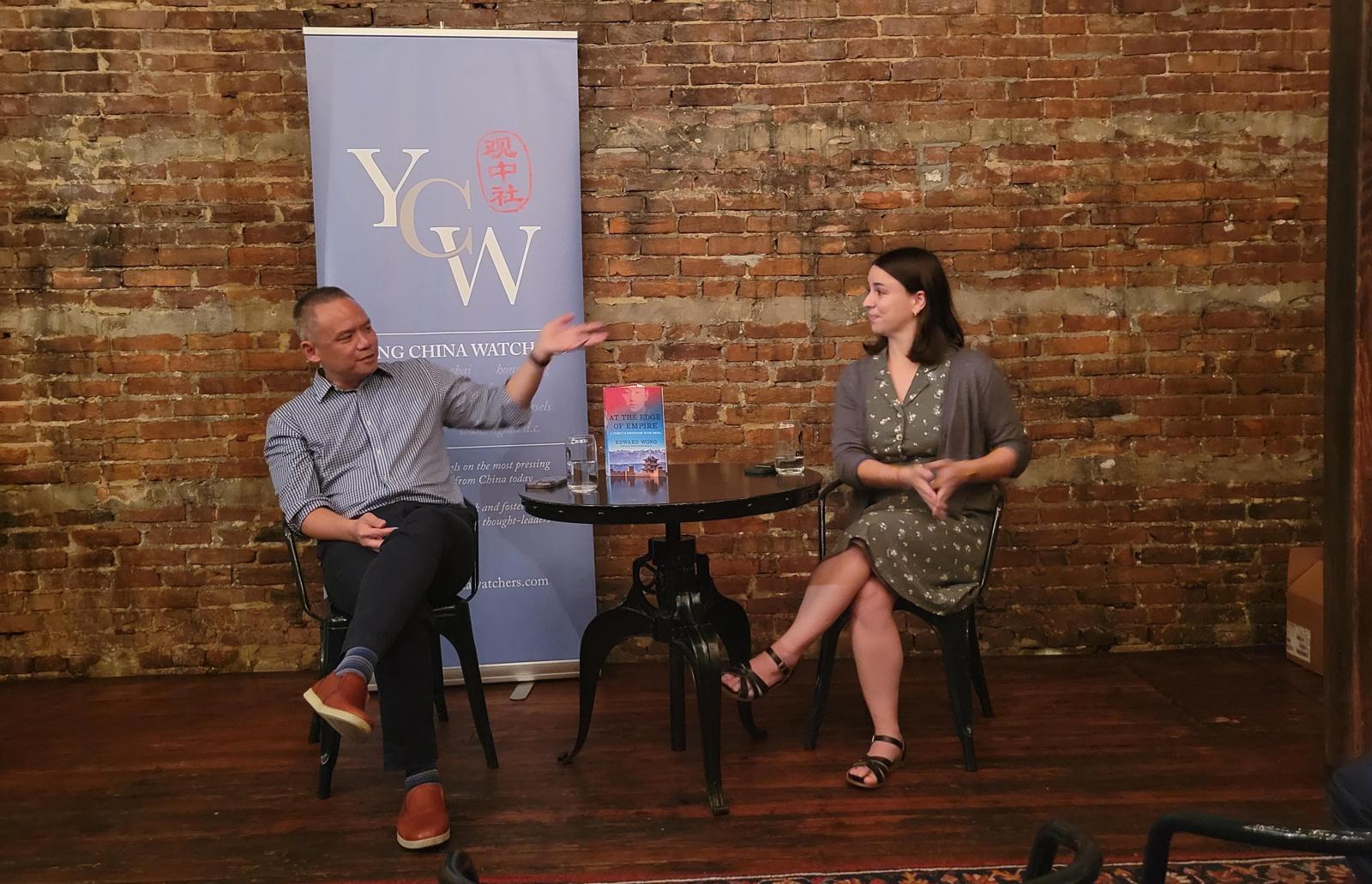
Rosie Levine in conversation with New York Times correspondent and author Edward Wong during a book talk on At the Edge of Empire: A Family’s Reckoning with China, 18 September 2025. From left to right: Edward Wong and Rosie Levine. Image provided by Rosie Levine.
YCW: How do you see the next generation approaching China differently today?
RL: I think the interest is still there, but the barriers are much higher. People are weighing that interest against the challenges of access, funding, and uncertainty. That makes it harder to gauge how much interest truly remains, because fewer people are able to act on it.
At the same time, communities like YCW play an invaluable role in keeping people engaged. Even if someone isn’t working directly in a China-focused role, they can still participate in discussions, attend events, and stay connected to the field.
YCW: USCET has evolved significantly since it began nearly 30 years ago. How would you describe its role today?
RL: USCET is a small organization, but that allows us to operate with a unique level of trust on both sides. Historically, we’ve had strong ties to the U.S. policy community, particularly the State Department, while also building long-standing relationships with partners in China.
Our role is very programmatic: we convene, we bring people together, and we create dialogue between experts who might not otherwise have the opportunity to engage. In today’s environment, that work has become more challenging. There are greater political sensitivities, operational risks, and declining willingness to participate. But precisely because of that, organizations like ours play an even more important role in maintaining channels of communication and reducing misunderstandings.
YCW: The recent USCET working group report highlights a sharp decline in Americans studying in China. What are the long-term consequences of this trend?
RL: The biggest concern is the erosion of the pipeline of China expertise. For decades, the U.S. understanding of China has relied on people with firsthand experience—students, researchers, and professionals who have spent time on the ground. With only around 2,000 Americans in China today, that pipeline is at risk. That affects not just academia, but government, business, and other sectors that rely on accurate, nuanced understanding. There’s also a compounding effect. As fewer people go, there are fewer mentors and fewer institutional connections, making it even harder for the next cohort to follow.
YCW: Can virtual exchange or remote research substitute for in-country experience?
RL: These tools are incredibly valuable, and they should absolutely be part of how we engage with China moving forward. But they cannot replace firsthand experience.
Without being on the ground, there’s a risk of missing important trends or relying on assumptions that don’t reflect reality. China changes rapidly, and the further removed you are from that reality, the greater the risk of misunderstanding. So while virtual engagement can complement, it shouldn’t be seen as a substitute.
YCW: What keeps you committed to this work, and what advice would you give to young people entering the field?
RL: I stay committed because this work is incredibly important, and because I continue to meet so many young people who are passionate about China. They come from all kinds of backgrounds—language learners, heritage speakers, students who discovered China through a single course—and they bring fresh perspectives to the field.
My biggest advice is to find a way to go to China if you can. Even a short visit can provide invaluable insight and help you test what you’ve learned against reality.
I would also emphasize that this is a very collaborative field. People are generally generous with their time and willing to mentor others. So reach out, ask questions, and build those connections. You might be surprised by how supportive the community can be.
Interview by Emily Brignand, Young China Watchers