Voices on China – Tony Chou is Here to Make You Laugh
Beijing is the city that defined contemporary China’s comedy scene, beginning as a foreign import in a few tucked-away Sanlitun bars and eventually developing into a major, mainstream cultural institution, launching TV shows, internet celebrities, and comedy careers to a national audience. As the scene blew up, comedian Tony Chou was at its center. He created one of the industry’s most recognizable brands, The Humor Section, which he co-founded with comedian Des Bishop and which has been featured in outlets including the BBC, CNN, The Atlantic, China Daily, CGTN.
Now based in both New York and Beijing, Chou continues to perform around the world in both Chinese and English. The Humor Section is still providing a platform for Chinese comedians, though it has evolved from spotlighting primarily Chinese comedians to showcasing Asian comedians from around the world, through both Chinese and English-language shows. Chou has evolved too: he still has his own comedic viewpoint, though the material continues to change in order to connect with audiences far from the Beijing open mics where he got his start.
He recently hosted a show featuring a range of Asian comedians at Asia Society, and appears frequently at comedy clubs across New York, including the Comedy Cellar.

Comedian Tony Chou on Stage at the Comedy Cellar in New York. Image provided by Tony Chou.
Young China Watchers (YCW): What first got you into comedy, and how did you get started?
Tony Chou (TC): I’ve always been drawn to expressing myself in front of people. In college, I represented my university in a lot of national English-speaking competitions, and then after graduation I became an English teacher. Teaching sharpened my sense of rhythm, language, and audience response, all of which later became incredibly useful in stand-up, even though I didn’t know it at the time.
The real spark came when I saw Joe Wong’s set at the White House Correspondents’ Dinner go viral in China. It was the first time I saw someone from a Chinese background doing stand-up comedy on that level in English, and it made me think it might be something I could do as well. So I started looking for comedy in Beijing around 2012. At the time, there was almost no local stand-up scene. But I was fascinated. I started signing up for open mics, going to shows, and just throwing myself into it.
Then in 2013, I met Des Bishop, who was in Beijing filming a documentary. He was producing English-language comedy shows at The Bookworm, and together we founded The Humor Section. We started by hosting English comedy shows, but very quickly, we realized there was an opportunity to build a real stand-up comedy scene for Chinese audiences. From 2014 onward, we expanded into Chinese-language comedy shows, and over time, The Humor Section helped foster the first generation of Chinese stand-up comedians, many of whom have since become household names in China.
YCW: You perform in both Chinese and English. As you’re crafting material in either language, have you observed any patterns in terms of what jokes work in Chinese that don’t work in English, or the other way around?
TC: Absolutely. Performing in Chinese and English can feel like working in two completely different psychological systems. English-language stand-up is much more built around individual perspective. You’re encouraged to have a point of view, to challenge things, to be distinct, even to make people a little uncomfortable. A strong comic voice is often about saying: this is how I see the world, and I’m willing to stand alone in it.
In Chinese culture, people are often trained to avoid conflict, avoid standing out too much, avoid making others uncomfortable, and to stay within a certain invisible emotional boundary. So even before censorship enters the picture, there is already a kind of internal restraint built into how people communicate. Then, there are structural issues in China as well. When certain topics, attitudes, or truths are structurally off-limits, comedy naturally gets pushed toward safer areas, like observational humor, dating, family, workplace behavior, small embarrassments; things that are relatable, but not material that’s going to rock the boat.
When I do comedy in English, I often feel more permission to push an idea all the way to its sharpest point. In Chinese, I’m often much more aware of what might not be being said, even if it’s being felt.
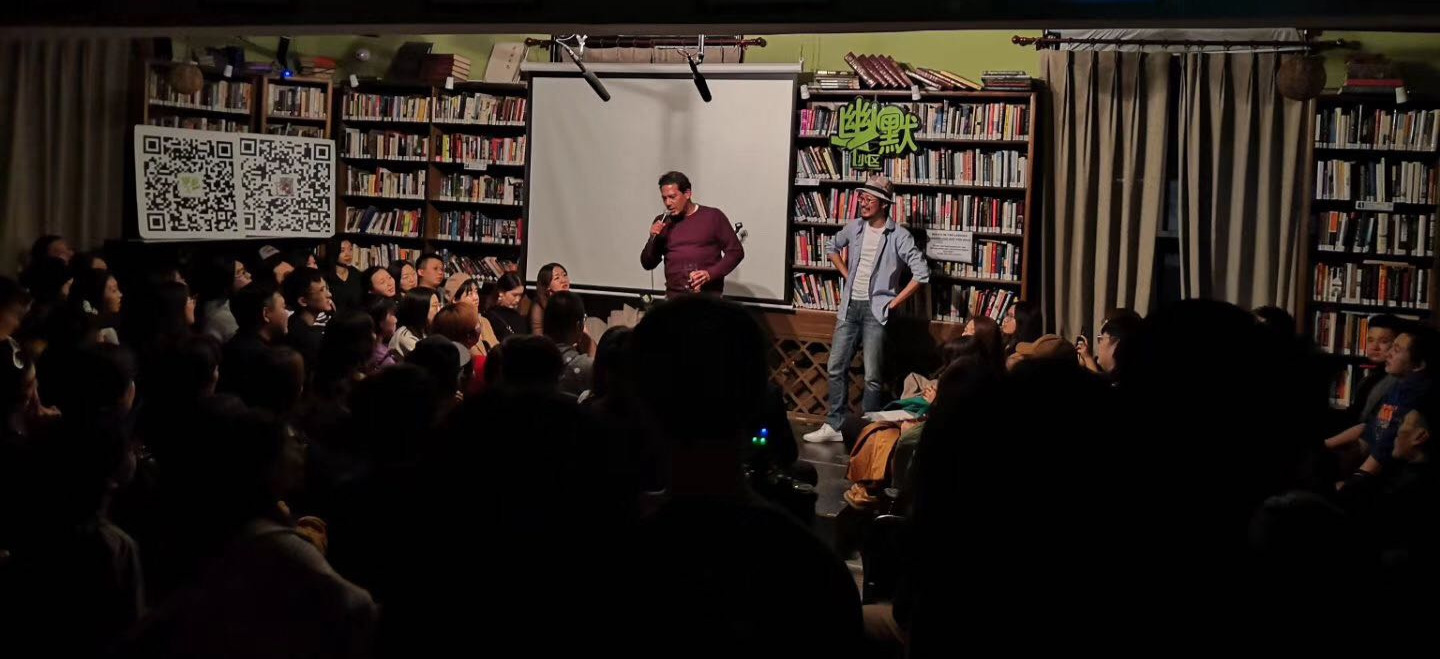
Tony Chou (right) on stage for The Humor Section at the Bookworm, in Beijing, circa 2019. Image provided by Tony Chou.
YCW: Chinese comedy has had ups and downs in the past few years. At first, it seemed as if comedy was unstoppable: audiences were growing, there was more interest from new comedians. Then, we saw the Li Haoshi incident in May of 2023 (when a very popular Chinese comedian and his company were publicly punished for making a politically sensitive joke), which was widely interpreted as a warning for comedians. What was your experience of the rise of Chinese comedy, and how do you view it now?
TC: What happened in China was remarkable. When I started, stand-up was still very marginal. Then over the years, it exploded. Audiences grew fast, more clubs opened, more people wanted to try comedy, and eventually being a comedian in China became not just a passion, but a real career path. If you became successful in stand-up at the right time, you could make very good money, sometimes even more than many comedians in America.
But while Chinese comedy was becoming bigger commercially, I was also witnessing more and more frustration around its limits. The more the industry grew, the more obvious it became that there were boundaries you were not supposed to touch. Those boundaries began to affect the entire spirit of the art form.
For me, the Li Haoshi incident was the moment when I really had to ask myself which I liked better: the business opportunity comedy presented, or the freedom of expression that’s inherent in the form? That’s a big reason why I moved The Humor Section to New York City.
Economically, honestly, that may not have been the smartest decision. Staying in China might have been a much better financial choice in the short term. The market was bigger in some ways, and there was more immediate commercial upside. But here, I have greater space for expression, so that felt like a good choice for us creatively.
YCW: New York has a number of comedians doing stand-up in Chinese. Can you give us an introduction to the community, and tell us how you fit in?
TC: To be honest, I wouldn’t say New York currently has a large or fully developed Chinese stand-up comedy scene. There are a few regular shows, like a weekly Chinese open mic and some smaller showcases, but overall it’s still quite limited in scale. And the way some of these shows operate is quite different from professional comedy clubs. In some cases, comedians are even required to submit scripts for approval beforehand.
Instead of trying to fit into the existing structure, I see myself as building something again. Right now, most Chinese-speaking audiences in New York are still heavily influenced by comedy shows from Mainland China, especially the style shaped by streaming platforms. But here, you’re not limited to one cultural system. You have Chinese-speaking comedians from mainland China, Taiwan, Singapore, Malaysia, and also people performing in Chinese as a second language. You have people who are influenced by completely different comedy traditions, especially the American stand-up scene.
So the real opportunity is to expand what Chinese comedy can be, building a scene that is more international, more open, and more artistically driven than what currently exists.
YCW: When you began to do stand-up overseas, what were some of the biggest differences you noticed? I’d love to hear your views both on Chinese vs overseas audiences, as well as Chinese and foreign communities you’ve been a part of.
TC: My first international comedy tour was back in 2014, when Des Bishop invited me to open for his Made in China tour across several cities in Ireland. Since then, I’ve done one or two international tours almost every year, and since the summer of 2023 I’ve been traveling and performing abroad extensively, spending roughly half my time in China and half overseas. Chinese audiences are often very sharp when it comes to social nuance, subtext, and human dynamics. But overseas, especially in places like the U.S., the U.K., or Ireland, there is generally more room for directness, stronger individual point of view, and a greater tolerance for discomfort or provocation in comedy.
I also noticed a difference in the communities. In China, stand-up grew very fast and became a real industry, with big audiences and strong commercial potential. Overseas, especially in mature comedy markets, the scene is often more competitive and less immediately rewarding financially, but the comedy culture itself is much deeper and more established.
YCW: You’ve performed in many countries internationally. Which country has the best audiences, and why?
TC: Honestly, I don’t think there’s a simple answer to that, because you can never fully predict what a crowd will be like just based on the country. Even in the same city, you can get completely different audiences depending on the neighborhood, the venue, the night, or even who happened to walk in. One room might be full of locals who live around the corner. Another room might be full of tourists who just got off international flights. Those are basically two different planets in comedy terms. So for me, I tend to think more in terms of “What kind of room is this?”
And actually, one thing people often assume is that a very international or very diverse crowd must be easier for a comedian like me, but sometimes it’s the opposite. A room with too many different nationalities, cultural references, and social instincts can actually be one of the hardest kinds of rooms to play. When a room is extremely mixed, sometimes you’re not just trying to be funny—you’re trying to get twenty different systems of perception to land in the same place at the same time. That can be hard, but when it does work, it can be amazing, because if you can make a highly mixed room laugh together, that usually means you’ve touched something more fundamental, almost universal.
Interview by Kit Mention.